





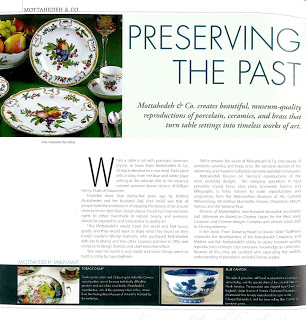
 "When a table is set with porcelain, ceramics, crystal, or brass from Mottahedeh & Co., dining is elevated to a new level. Each piece tells a story, from the blue and white place setting of the colonial elite to the vibrantly colored personal dinner service of William Henry, Duke of Gloucester.
Founded more than eighty-five years ago by Mildred Mottahedeh and her husband, Rafi, their belief was that all people hold the entitlement of enjoying the beauty of art around them to enrich their lives. Social classes should not have exclusive rights to either man-made or natural beauty, and everyone should be exposed to and have access to quality art.
"The Mottahedehs would travel the world and find luxury goods, and they would want to share what they found on their travels," explains Wendy Kvalheim, who purchased Mottahedeh with her husband, and two other business partners in 1992, and serves as its design director and chief executive officer.
"But now the world is very small, and exotic things aren't so hard to come by," says Kvalheim.
Still it remains the vision of Mottahedeh & Co. that pieces of porcelain, ceramics, and brass, once the exclusive domain of the artistocracy, and museum collections become available to everyone.
Mottahedeh focuses on historical reproductions of the most enduring designs. The company specializes in hard porcelain, crystal, brass, silver plate, stoneware, faience, and lithographs. It holds licenses to make reproductions and adaptations from the Metropolitan Museum of Art, Colonial Williamsburg, Winterthur, Monticello, Historic Charleston, Mount Vernon, and the National Trust.
Patterns of Mottahedeh's time-honored decorative accessories and tableware are based on Chinese Export from the West, early European and Chinese designs. Complex and vibrant colors add to the exquisiteness.
In her book, "From Drawing Board to Dinner Table," Kvalheim chronicles the development of the Mottahedeh Company, and Mildred and Rafi Mottahedeh's ability to create museum-quality reproductions through their extensive knowledge as collectors. Because of this, they are credited with expanding the world's understanding of porcelain's ancient Chinese origins.
Mottahedeh collectors cite the reason for their love of the company's distinctive porcelian; Shapes are complex, unusual and historic; a large majority of the products are made from hard porcelain, which is what the Chinese used; and the pieces are highly decorated.
Kvalheim explains why the colors of Mottahedeh's pieces stand out. "The industry average for colors on a dinner plate are four to ten colors. At Mottahedeh, we start at four and make decorations with up to twenty-seven colors. Our average is sixteen colors," she says.
Handicrafted Brass
Handicraft brass is another Mottahedeh specialty. It is revered by collectors, and awe-inspiring for those who receive Mottahedeh brass as a gift. The company's handicraft brass is special because of the detail in the work; the extravagant decoration and shapes of the pieces, which are derived from antiques; and the heavy weight of the pieces.
Mottahedeh does not mass-produce any of its brass, and each piece is made by hand. Its highly decorated pieces are truly one of a kind because of variations of the artist making the item.
In creating its brassware and silver plate collection, Mottahedeh reproduces objects from such oustanding historical institutions as Historic Charleston, Historic Natchez, Stately Homes of England, and the Winterthur Museum.
"People can copy a lot of things, but they can't make what we make. The difference about all of Mottahedeh's reproductions is in the complexity of the design and the subtlety of color," says Kvalheim.
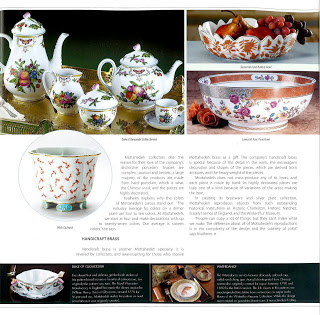
Patterns seen in this article: Duke of Gloucester; Tobacco Leaf; Blue Canton; Sacred Bird & Butterfly; Lowestoft Rose Punch Bowl; Water Dance; Wufu Cachepot