





So we've chosen our table, we've decided on a table cloth (or perhaps placemats) but what do we do with these plates? what is this small one used for? There's this even smaller one? Oh wait, one is a saucer? Okay, but there are still two other small plates... And then there's a large one and an even larger one? WHAT?! Why so many? and what am I supposed to do with a 5 piece place setting?!?! What pieces even make up a 5 piece place setting??
It's all confusing, I know. But let's break it down.
Service Plate ~ (aka Presentation Plate)
Not always necessary, a service plate is larger than a regular dinner plate. It holds the place of the person sitting at the table to make it look complete before everyone sits and starts to eat. They are often used for this effect in finer restaurants that don't use placements. The waiter will remove this plate before bringing you your food on a new plate for the first course.
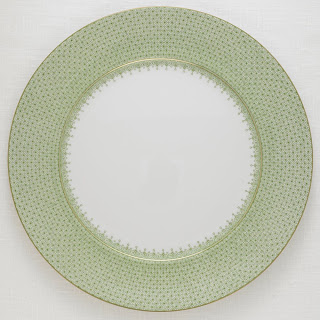 We like to use these at home for a formal setting because they can add beautiful color to the table presentation when people enter the room. Rather than picking them up before the first course, you can put a smaller plate right on top of it and continue using the service plate as a base for the other plates of the meal. In this way it is treated as a 'frame' for your dinner presentation and gives a uniformity to your table. When used in this way, service plates should be placed on the table about 1 inch from the table's edge so that when the other plates are centered on it your guests don't have to lean too far forward to get to their food.
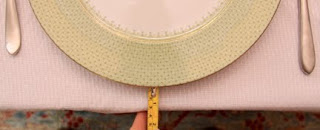 Sometimes people really like a big plate - especially for buffets. Because service plates are bigger than regular dinner plates, they can be used as a large dinner plate, or even as a platter to serve desserts and cakes. I use them regularly to serve side courses in family-style, or watermelon on a hot summer day to guests that stop by.
Dessert Plate ~ (aka Salad Plate)
Dessert plates are the most popular fancy plate sold. The reason being that dessert plates are less expensive than a dinner plate because of their size. To dress up a table you will need two of these plates. The first you would use for the appetizer course, and the second would be used for the dessert course. Many brides like to register for a highly decorated dessert plate of one pattern, and a simpler dinner of a different pattern that matches.
If there are no other plates on the table, the salad plate (dessert plate) should be placed about 4 or 5 inches from the edge of the table. If you have a service plate or a dinner plate already on the table the salad plate can be placed right on top for the appetizer course!
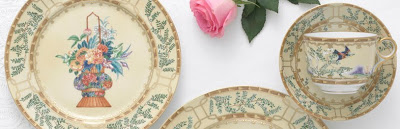 Dinner Plate
For the big event you can serve the main course in one of three ways.
- Stack the plates in the kitchen and put the food on the plate, carrying one plate for each person and placing it in front of each seated guest, as in a restaurant or at a wedding.
- Have the dinner plate already on the table and serve the meal in serving bowls that are passed by the guests. In this case, the serving bowl or platters are passed to the RIGHT so that everyone gets at least a chance to try those famous sweet mashed potatoes!
- Have a server carry the serving bowls or platters to each place and allow the guests to spoon the amount that he or she wants onto their own individual plate.
Again, the dinner plate should be placed 1 inch from the edge of the table in the center of each place area. If there is a distinctive "up" to the image on the plate, make sure that it is placed with the image facing the proper way so that the seated person gets the best view. Nothing like sitting at a table with a bird hanging upside-down "Should I stand on my head or rotate the plate?" Growing up around porcelain, my first reaction when I sit down at a table is to align my plate perfectly. I don't even realize I'm doing it! But I've received a few glares from my husband as I sit there fidgeting with my place setting.
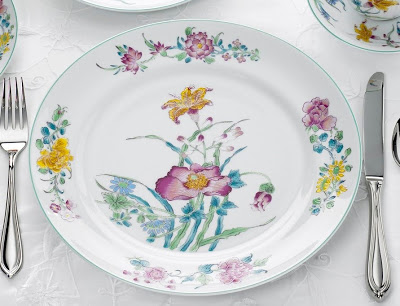 One fun way to set the table, especially if you don't have enough of the same plate for everyone is to mix your dinner plates by alternating your designs so one person has a different dinner plate than the person next to them. Just make sure the hues are all relatively similar - as this will add a degree of uniqueness to your table, but still keep it all consistent.
Bread and Butter Plate ~ (aka B&B)
This should go on the table to the left of the dinner plate. A lot of people are not used to having a bread plate on the table and so they often don't know which plate is theirs. This is especially true at weddings when 10 people are crammed around a small round table and there are plates and silverware EVERYWHERE!
 On countless occasions I've experienced this scenario,
"Oooh! Warm bread!"
you look to your left - someone is using that little plate. You look to your right, someone else is using that other little plate. "Where's my bread plate!?" everyone at the table looks around for an empty plate (which is usually found on the other side of the table). "Could I please have that extra plate? Mike took mine."
ALWAYS go for the plate on the LEFT. If there are individual butter knives, these will be placed diagonally on the right upper corner of each plate, so that the diner can reach it with the right hand to butter their biscuits. This plate is too small to serve as a salad plate, but can be used to plate a small appetizer, or as an under plate for a small cup or mug of soup.
When buttering your bread, don't take a slice, slather it with butter, and eat it like you're eating peanutbutter toast! Instead, serve yourself a dollop of butter (thus the reason they're in butter balls sometimes) and place it on your B&B plate. Then, tear off bite size pieces of bread and butter each piece before daintily stuffing your face. Tear, butter, chew, repeat. This is considered polite.
Cup & Saucer
In porcelain tradition cups and saucers are used to serve tea or coffee for dessert (or after the dessert - as is the European tradition) A European coffee cup refers to a demi-tasse or "half-cup" used for espresso and is smaller than a regular cup and saucer.
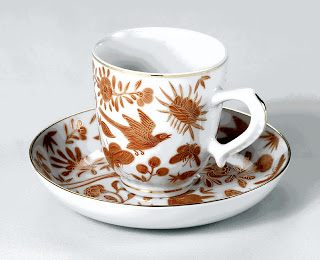 Cups and saucers are generally not displayed with the service, dinner, salad, and b&b plates, but they are commonly displayed after with the dessert plates (which double as salad plates). After the main course has been removed from the table you can put a cup and saucer at each guest's spot. Make sure to have a sugar bowl and creamer (milk pitcher) on the table so that your guests can use them if they are not of the variety of human that prefers black coffee. In our household many a man and woman prefer their coffee very strong and black. However, I almost always prefer the sweeter variety of caffeine.
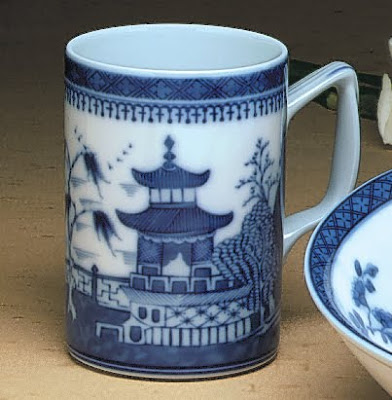
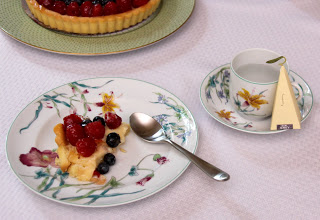 Another option is to put the sugar and creamer on a tray and carry it from person to person. Fill each cup as the diners are seated, or serve the coffee and tea by pouring into all the cups assembled on a side table or from the kitchen. Alternately, dressy mugs are coming into fashion and are acceptable in a formal setting if they are of fine material.
 5 Piece Place Setting ~ (aka 5pps)
The tradition 5 Piece Place Setting is composed of a Dinner, Dessert, Bread Plate, Cup & Saucer. These 5 pieces are often sold in a set because they give you all the basic pieces you'll need to set a tradition table. Brides and customers often register for patterns that work together. Just because a pattern is sold in a 5pps - it doesn't mean you can't mix & match. The most important thing about buying porcelain is not being afraid to use pieces in what-ever way you feel comfortable. Ultimately, you're doing the hosting - you get to choose what you use it for. For instance, I love using dessert plates as small dinner plates when it is just my husband and I eating dinner together. I am less inclined to eat as much, and they take (just lightly) less effort to clean. It's okay to use a plate - tradition or not - any way you want. In this age of internationalism and lack of convention, it is great to know that you can be creative. The format of setting the table is for convenience of use.
Check back next week for a Mottahedeh Memo about the confusing world of cutlery.