





We know Tobacco Leaf as a plant used for smoking as cigarettes and cigars. Our Tobacco Leaf, however, defies definition, tradition, and current ideas about dinnerware. For instance, the thought that plates need to have clean white centers to display food well.
Other designers try to mimic this pattern, but the balance and color are perfect and a copy of our reproduction is rarely well achieved. Four firings plus gold hand painting make this special.
You would think that young people prefer simple patterns and it is true that they often do. In spite of this point, Tobacco Leaf is a very active bridal pattern.
The Nicotiana plant itself is a colorful miracle. The plant was first recognized as an important cash crop by explorers to the New World (America), as tobacco had been in use for several hundred years and was highly prized. An added benefit is that the climate of North America was ideal for its growth. The flowers are pink, sometimes orange and yellow and the leaves are large and curling in varying shades of green. They remind us of spinach leaves. All-in-all it is a beautiful and colorful plant.
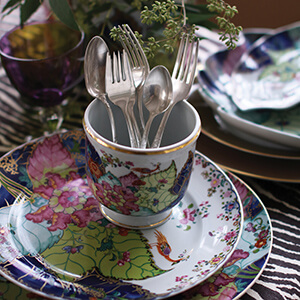
Tobacco Leaf is One of Our Most Popular Dinnerware Patterns.
Tobacco Leaf is one of eleven styles of Chinese decoration classified in this genre, said Eleanor Gordan, noted Chinese export porcelain dealer and historian. Mottahedeh’s design was originally a reproduction of plates in the collection of the Metropolitan Museum of Art in NY City and was licensed by that institution. It is known for its bold brilliant colors and all-over leaf design.
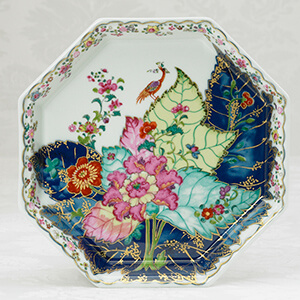
Pheonix is the Symbol of Eternity.
Whoever was the creator of this design could not know that his/her creation would appeal to people for centuries to come.
It is appropriate that in our version, a small phoenix bird perches on the plant.
A phoenix is a mythological bird that passes through the stages of birth, life and death by fire and rebirth. Associated with fire and the sun, a phoenix obtains new life by arising from the ashes of its predecessor. In this way it is eternal. Many cultures have adopted the phoenix in their mythology. For some, the tears of the phoenix have healing powers.
According to David Howard, noted Chinese export porcelain historian, this pattern was probably derived from Indian textiles, though the original plate was possibly developed for the Portuguese and Brazilian markets circa 1780. Variations include birds and figures among broad leaves.
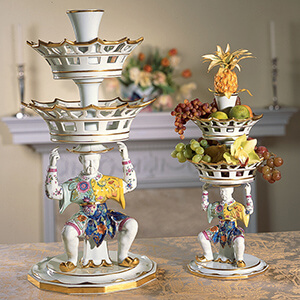
Tobacco Leaf is not Just Dinnerware
If you think that Tobacco leaf is too much as dinnerware because you would like a simpler plate, you might consider some of the many wonderful decorative accessories to place in your home: The Man Epergne, designed in collaboration with former U.S. Vice President Nelson Rockefeller by Mildred Mottahedeh; The Divina Vase that displays large floral arrangements spectacularly; The Dessert Tray for a fancy buffet; and (not to be forgotten) a Tobacco Leaf Ginger Jar Lamp, to name a few.
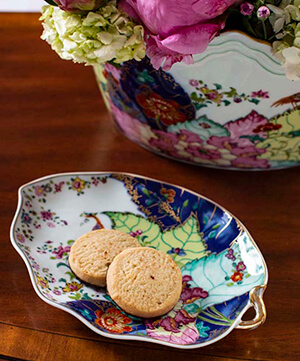
Tobacco Leaf Incorporates 27 Colors And Gold.
How do we get those colors on a plate, you ask? It is not that easy. We make a silk screen of the design and each screen is a color. People in the industry aim for a maximum of 8 colors and only a few companies have the know-how to print more because the colors are made with oxides or earth such as iron, copper, sulphur, cobalt, etc., rather than paint. They melt when they get to very high temperatures (like over 2000 degrees fahreinheit). The trick is to get the colors all to melt at the same time, maintain their desired hue, fuse smoothly into the clear glaze of the plate without reacting with each other. The more different colors, the more complicated it gets. As you can guess, Tobacco Leaf is the most complicated, but right up there with Merian dinnerservice with 25 colors and gold.
We hope you love Tobacco Leaf as much as we do and it will be part of your memories of home.
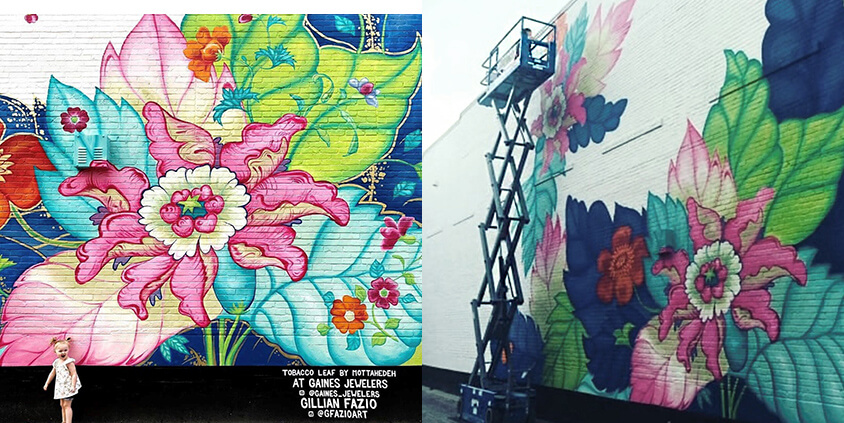
News! Gaines Jewelers of Lakeland , Florida strove to update their look and chose this 200+ year old design to make a statement. They installed an entire exterior wall mural 20 feet high and 30 feet wide.(Last winter. It is outrageously colorful and wonderful. The artist is Gillian Fazio @gfazioart ! Stop by some time and see this experience in person. Hats off to Gaines!