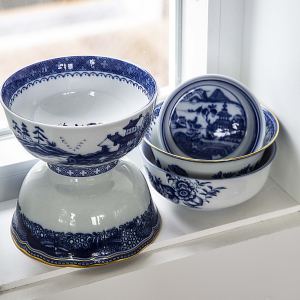





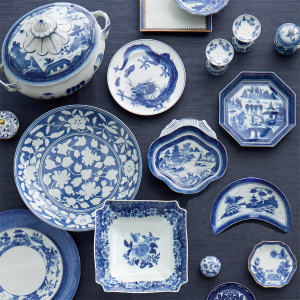
Are you a blue person or a warm colors person? We find that most people have a preference in their décor or clothing. Then there are the people who prefer beige or white and people who love gray. We don’t have a category for the people who decorate with red and black.
At Mottahedeh, we specialize in Blue and White and make some of the best high fire cobalt porcelain made today. We make other kinds of blue and the full range of colors, not limited to any one style.
Whatever it is, it is all the way!
Our position is: “Whatever it is, it is all the way”. And it has a pretty good story.
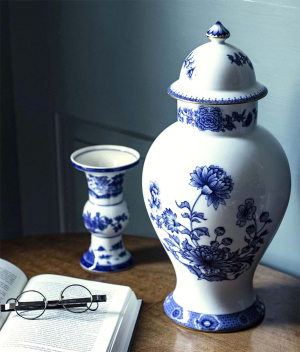
Here we will tell you what we know about high fire cobalt blue.
Cobalt blue is a deep navy color leaning toward the purple side. It has a melty look, while maintaining distinct linework and images. One interesting point is that it is volatile in the kiln. That is, it can look somewhat crisp and black when fired at lower temperatures, a pleasing softness at mid-range firing, and gray and washed-out look at temperatures that are too high. It is not easy to gauge.
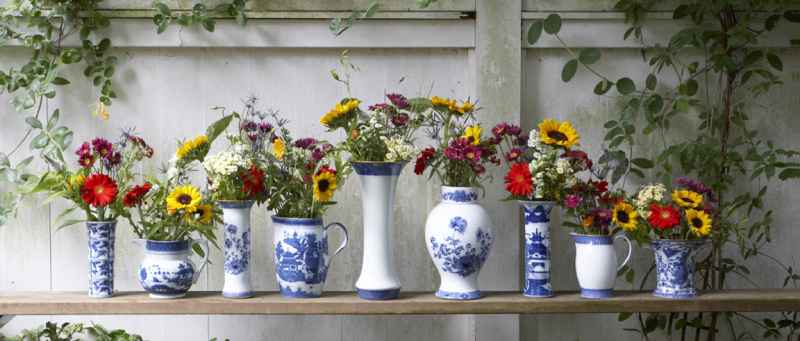
Blue and white porcelain go together like soup and sandwich.
Or love and marriage. You can’t have one without the other, as the song goes. Ceramics of various forms were in existence in 800 AD in Iraq and Iran. In our mind, the reason it was so early and so prevalent is that cobalt was one of the first stable colors to be discovered, along with copper and iron.
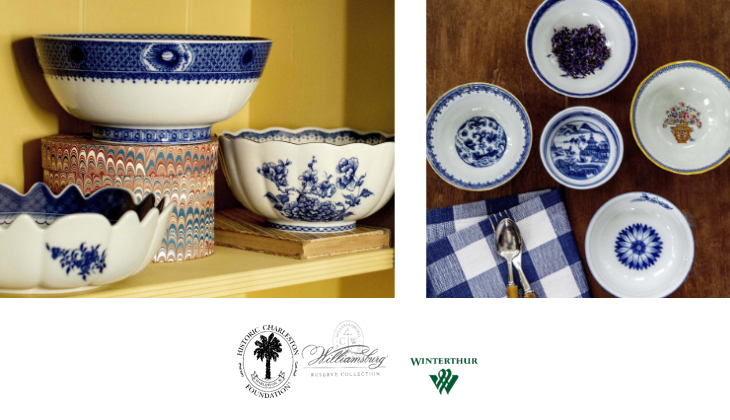
As time went on, with the discovery of the diverse properties of natural earths, other colors became possible.
Later, about 1600 and 1700’s, when trade expanded between Europe, the Orient and the New World, the full range of color and treatment became known and possible. But this was a secret of porcelain was guarded by China for more than a few centuries. The secret to high fire porcelain was the addition of Kaolin (decayed granite). Color secrets were revealed next, through espionage and various nefarious ways.
The fashion to own porcelain became a passion with nobility of all nations and especially the royalty of Europe. For the Americans in the less-affluent New World, they could afford blue and white porcelains while the affluent of Europe received multicolor, and thus more expensive wares.
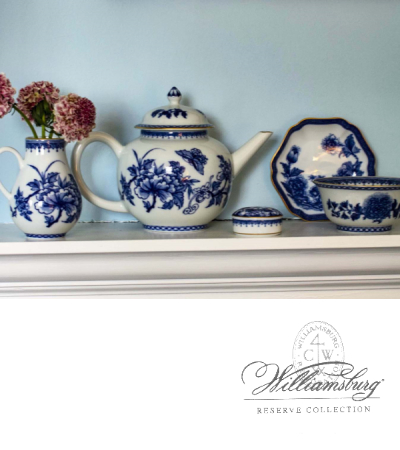
One characteristic of Chinese porcelains of the day was the color of the body; it has a gray look, because the clay had a high amount of iron in it. Blue on gray has a nice appearance. Since we make historically correct dinnerware, we use gray body on those items that originated that way: Tobacco Leaf, Blue Canton, to name a couple.
Because Cobalt Blue is universal, no matter what its age, high fire blue, as we call it, can be mixed with a myriad of decorations in cobalt, expanding your blue and white wardrobe.
Blue is not coming back, because it never went away.
People often say, Blue is coming back when they see it predominate in the marketplace. Blue is not coming back, because it never went away. It is as constant as the blue sky above. Blue and White, blue and yellow, blue and red. Eternally refreshing.
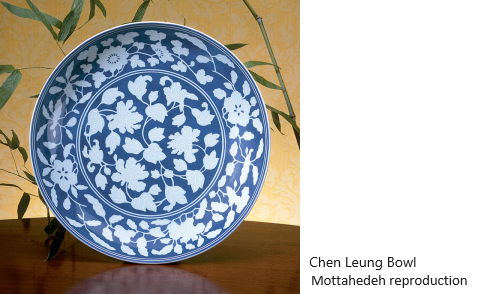
We don’t try to make our antique reproductions look old.
We want them fresh and crisp while maintaining the intent of the original. Mrs. Mottahedeh used to say that making a reproduction is making an art form accessible to all classes, in the same way that a Shakespeare play is a reproduction of the original and enjoyed by theatre-goers today because it is relevant today.
Some history from Encyclopedia Britannica:
Blue-and-white ware, white porcelain decorated (originally) with blue under the glaze. At least as early as the 9th century, underglaze blue had been used in the Middle East, whence it was introduced to China in the Yuan dynasty (1279–1368). Particularly notable are the blue-and-white wares produced in China during the Ming (1368–1644) and Qing (1644–1911) dynasties. From China, underglaze blue was introduced to Europe.